
Ontario winters can create very different snow-management challenges depending on the property, snowfall and available space. While terms such as snow clearing, snow removal, and snow plowing are often used interchangeably, they can describe different tasks. Understanding the difference helps property owners choose the right service before winter weather creates access and safety problems.
What Does Snow Clearing Mean?
Snow clearing generally refers to moving accumulated snow away from areas where people and vehicles need to travel. The goal is to restore access rather than necessarily transport the snow completely off the property.
For example, a commercial parking lot may receive several centimetres of snow overnight. A contractor can plow the snow from driving lanes and parking areas toward designated areas around the property. The snow has been cleared from the active surfaces, but it remains on-site.
This approach is common for:
- Commercial parking lots
- Retail properties
- Industrial facilities
- Office buildings
- Condominiums
- Multi-residential properties
- Private roads and access lanes
The exact approach depends on the site’s layout, snowfall volume and available snow-storage areas.
For Ontario property owners, professional snow and ice removal services may include several activities rather than one single task.
Snow Clearing vs. Snow Removal: What Is the Difference?
The easiest way to understand the distinction is to look at where the snow ends up.
Snow clearing: Snow is moved away from active surfaces such as driveways, parking spaces, sidewalks and access lanes, usually to another location on the same property.
Snow removal: Snow is collected, relocated or transported away when there is not enough suitable space to store it safely on-site.
In practice, the two services can overlap. A contractor may begin by clearing a parking lot and later determine that accumulated snow needs to be removed from the property.
The difference becomes especially important after repeated storms. A property may have enough room to store snow after the first few events, but those storage areas gradually become smaller. Eventually, snow piles can interfere with visibility, parking capacity, drainage and pedestrian movement.
That is when simple clearing may no longer be enough.
How Snow Plowing Fits Into the Process
Snow plowing is one of the most common methods used for snow clearing.
A truck, loader, skid steer or other piece of equipment pushes snow across a surface and places it in a designated area. The equipment and technique depend on the size and design of the property.
For a small commercial parking area, a plow truck may handle most of the work. Larger industrial properties can require loaders, skid steers and additional equipment to manage large snow volumes efficiently.
Snow plowing is particularly useful for quickly reopening:
- Parking lots
- Drive lanes
- Private roads
- Loading areas
- Building entrances
- Access routes
However, plowing alone does not necessarily address every winter maintenance requirement. Snow can remain along curbs, around entrances or in pedestrian areas, while compacted snow and ice can continue creating difficult walking conditions.
A complete winter maintenance plan may therefore combine plowing with sidewalk clearing, de-icing and other snow-management activities.
When Does Snow Need to Be Relocated?
Snow relocation becomes necessary when existing snow-storage areas are becoming a problem.
Imagine a retail plaza after several major storms. The first storm may produce manageable piles along the outer edges of the parking lot. After the second or third storm, those piles become larger and begin occupying valuable parking spaces.
At that point, simply pushing more snow toward the edges is not a practical long-term solution.
Snow relocation involves moving accumulated snow from one part of the property to another location where it can be stored more safely or efficiently. Depending on the site, this may involve loaders, snow blowers, dump trucks or other specialized equipment.
Relocation can help address problems such as:
- Reduced parking capacity
- Blocked sightlines
- Restricted pedestrian routes
- Obstructed entrances
- Limited drainage space
- Large snow piles around buildings
- Reduced access for emergency or service vehicles
The decision should be based on the property’s layout and the amount of snow already stored on-site.
When Is Snow Removal From the Property Necessary?
Snow removal takes the process a step further.
Instead of simply moving snow around the property, accumulated snow is loaded and transported away to an appropriate location.
This can become important when a property has limited space for snow storage. Dense urban properties, busy commercial centres and properties with underground parking can face this challenge particularly often.
Snow removal may be considered when:
- Snow piles are taking up too much parking space.
- Snow is blocking pedestrian or vehicle access.
- Sightlines at entrances and intersections are becoming restricted.
- Additional storms are expected.
- On-site storage areas are already full.
- Snow piles could interfere with drainage as temperatures rise.
- The property requires consistently open operating areas.
Removing snow from the property can also make it easier to maintain usable space throughout a prolonged winter season.
Why Snow Management Gets More Difficult After Multiple Storms
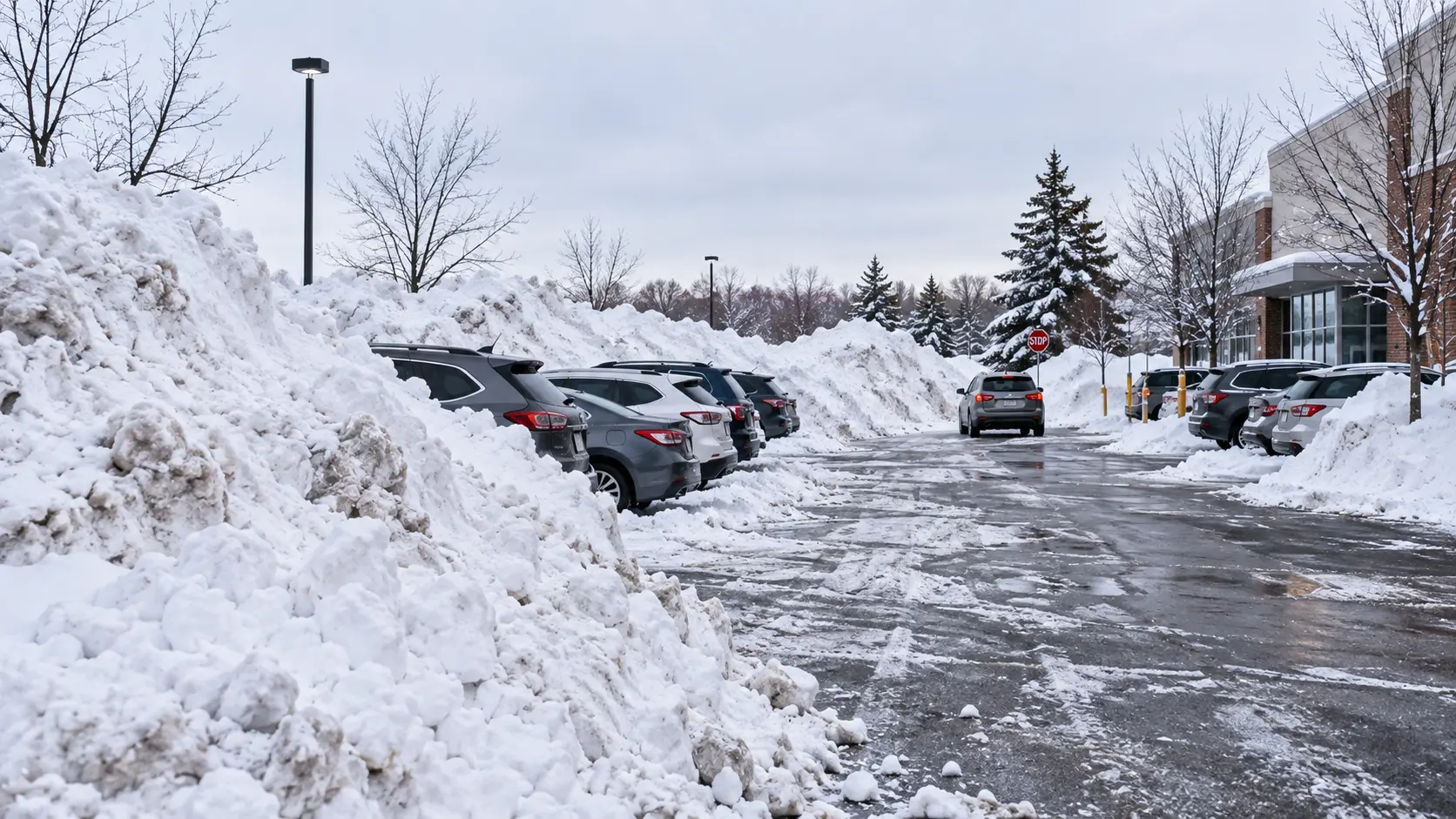
One of the biggest mistakes property owners can make is evaluating each snowfall as an isolated event.
Ontario winter conditions can involve repeated snowfall, freezing temperatures, thawing and refreezing. A property that handled one storm comfortably may struggle after several consecutive events.
Consider a parking lot that receives 15 cm of snow. After plowing, most of the snow is pushed to the perimeter.
A second storm adds another 10 cm. The contractor clears the lot again, but the existing piles are now larger.
After another storm, there may be very little room left to push snow without affecting parking spaces, visibility or pedestrian routes.
This is where snow management becomes more than simply moving snow out of the way.
Property managers should consider the entire season, including:
- Expected snowfall frequency
- Available snow-storage areas
- Parking requirements
- Pedestrian traffic
- Drainage
- Property access
- Building entrances
- Equipment access
- Potential accumulation around critical areas
Planning ahead can prevent a manageable snow event from turning into a property-access problem.
Snow Clearing for Different Ontario Properties
Not every property should be managed in exactly the same way.
Commercial Properties
Retail plazas and commercial buildings often have concentrated traffic during business hours. Parking spaces, entrances, pedestrian routes and vehicle lanes all need to remain usable.
Snow clearing should therefore prioritize high-traffic areas and maintain safe access while preserving as much parking capacity as possible.
Industrial Properties
Industrial sites may have large yards, loading docks, truck routes and employee parking areas. Heavy equipment and large vehicles can make access particularly important.
Snow may need to be pushed farther away from loading areas or relocated when storage space becomes limited.
Condominiums and Multi-Residential Properties
Residential properties require attention to both vehicle and pedestrian movement. Parking lots, sidewalks, building entrances and internal roads may all require different treatment.
For these properties, a snow-management plan should account for residents moving through the property at different times of the day rather than focusing only on vehicle access.
Private Roads and Access Routes
Long private roads and access lanes can require repeated clearing throughout a storm. Keeping the primary route open may be more important than clearing every section at the same time.
A contractor can prioritize routes based on property use, traffic patterns and operational requirements.
Why Snow and Ice Management Should Be Planned Together
Snow clearing addresses accumulated snow, but winter safety does not stop there.
After snow has been cleared, compacted snow and ice can remain on walking surfaces. Melting during the day can also refreeze when temperatures drop, creating slippery conditions around entrances, sidewalks and parking areas.
That is why snow management often works best when clearing and ice control are considered together.
Depending on the property, winter maintenance may include:
- Snow plowing
- Sidewalk clearing
- Snow relocation
- Snow removal
- De-icing
- Ice treatment
- Entrance clearing
- Monitoring after significant weather events
A coordinated approach helps property managers respond to changing conditions rather than treating every winter event as the same problem.
Choosing the Right Snow Clearing Approach
There is no single snow service that works for every Ontario property.
Before selecting a service, property owners and managers should consider a few practical questions:
Where can snow be stored safely?
If there is adequate space, on-site clearing may be sufficient for many storms.
How much traffic does the property receive?
High-traffic commercial and industrial properties may require faster and more frequent service.
How quickly must the property reopen?
A business that operates early in the morning may require overnight or early-morning snow clearing.
What happens after several storms?
A plan should account for snow accumulation throughout the season, not just one snowfall.
Are pedestrian areas included?
Parking lot clearing alone does not address every winter access issue.
Could snow piles become an obstruction?
Large piles can affect parking, visibility, drainage and access.
Answering these questions can help determine whether a property needs basic snow clearing, regular snow plowing, snow relocation, full snow removal, or a combination of services.
A Practical Snow Management Strategy for Ontario Properties
A strong winter plan usually starts before the first major snowfall.
Property managers should identify snow-storage areas, critical access points and pedestrian routes in advance. Equipment requirements and service priorities should also be established before severe weather arrives.
During the season, the approach can then change as conditions change.
For example:
- Initial snowfall: Clear driving and walking surfaces.
- Repeated snowfall: Continue clearing while monitoring snow-storage capacity.
- Growing snow piles: Relocate snow away from high-use areas.
- Limited storage: Arrange for snow removal from the property.
- Freezing conditions: Address remaining snow and ice on pedestrian surfaces.
- Thawing periods: Monitor drainage and areas where melting snow may refreeze.
This layered approach is more practical than treating snow management as a single service performed after every storm.
Understanding the Terminology Makes Winter Planning Easier
Snow clearing, snow plowing, snow relocation and snow removal all play an important role in winter property maintenance, but each serves a slightly different purpose. Snow clearing focuses on keeping parking areas, roads, walkways and access points usable, while snow plowing is one of the primary methods used to clear accumulated snow. Snow relocation involves moving snow to a designated storage area, whereas snow removal takes it completely off the property when there is no longer enough suitable space to store it.
For Ontario property owners and managers, understanding these differences makes it easier to plan the right winter maintenance strategy based on the property’s layout, traffic and snow-storage capacity.
At Greenland Irrigation, effective winter snow management is about more than simply pushing snow out of the way. It means maintaining safe access, protecting usable property space and adapting the approach as snowfall and winter conditions change. Whether managing a commercial property, industrial facility, condominium or multi-residential site, the right combination of snow clearing, plowing, relocation and removal can help keep the property accessible and operational throughout the winter season.
Frequently Asked Questions
Is snow clearing the same as snow removal?
Not always. Snow clearing generally means moving snow away from active areas such as parking lots, roads and sidewalks, while snow removal typically involves taking accumulated snow away from the property when on-site storage is no longer practical.
What is snow plowing?
Snow plowing is a method of clearing snow. Plows push accumulated snow from roads, parking lots and other surfaces toward designated storage areas.
When should snow be relocated?
Snow may need to be relocated when existing piles are occupying parking spaces, restricting access, reducing visibility or creating other operational problems.
Do commercial properties need both snow clearing and snow removal?
It depends on the property. A site with sufficient snow-storage space may primarily require clearing and plowing. Properties with limited storage capacity may eventually require snow relocation or removal as snowfall accumulates.
Does snow clearing include ice removal?
Not necessarily. Snow clearing and ice control can be separate services. Depending on the service plan, de-icing, sidewalk treatment and other ice-management measures may be included alongside snow clearing.