
Snow accumulation can quickly become a challenge for commercial properties during winter. Parking spaces disappear, drive lanes become narrower, entrances become harder to access and snow piles continue growing after every snowfall.
For property managers, one important question is whether regular snow plowing is enough or whether accumulated snow needs to be removed from the property entirely.
Although snow plowing and snow hauling are both part of commercial winter maintenance, they serve different purposes. Plowing moves snow away from active surfaces, while hauling involves loading and transporting accumulated snow to another location.
Understanding the difference can help businesses plan their winter maintenance budgets, manage limited parking space and maintain access across commercial and industrial properties.
In this guide, we explain snow plowing vs. snow removal, how snow hauling services work, when snow relocation is necessary and what property managers should consider before arranging winter maintenance.
What Is Snow Plowing?
Snow plowing is the process of using specialised equipment to push accumulated snow away from designated surfaces, such as parking lots, driveways and internal access roads.
The objective is to clear usable space by moving snow towards designated storage areas, usually within the property.
For commercial properties, snow plowing may cover:
- Parking lots and parking spaces
- Driveways and vehicle access routes
- Internal roads and turning areas
- Commercial entrances and exits
- Industrial yards and loading approaches
Snow plowing is generally the first step in managing accumulated snowfall because it removes bulk snow from areas that need to remain accessible.
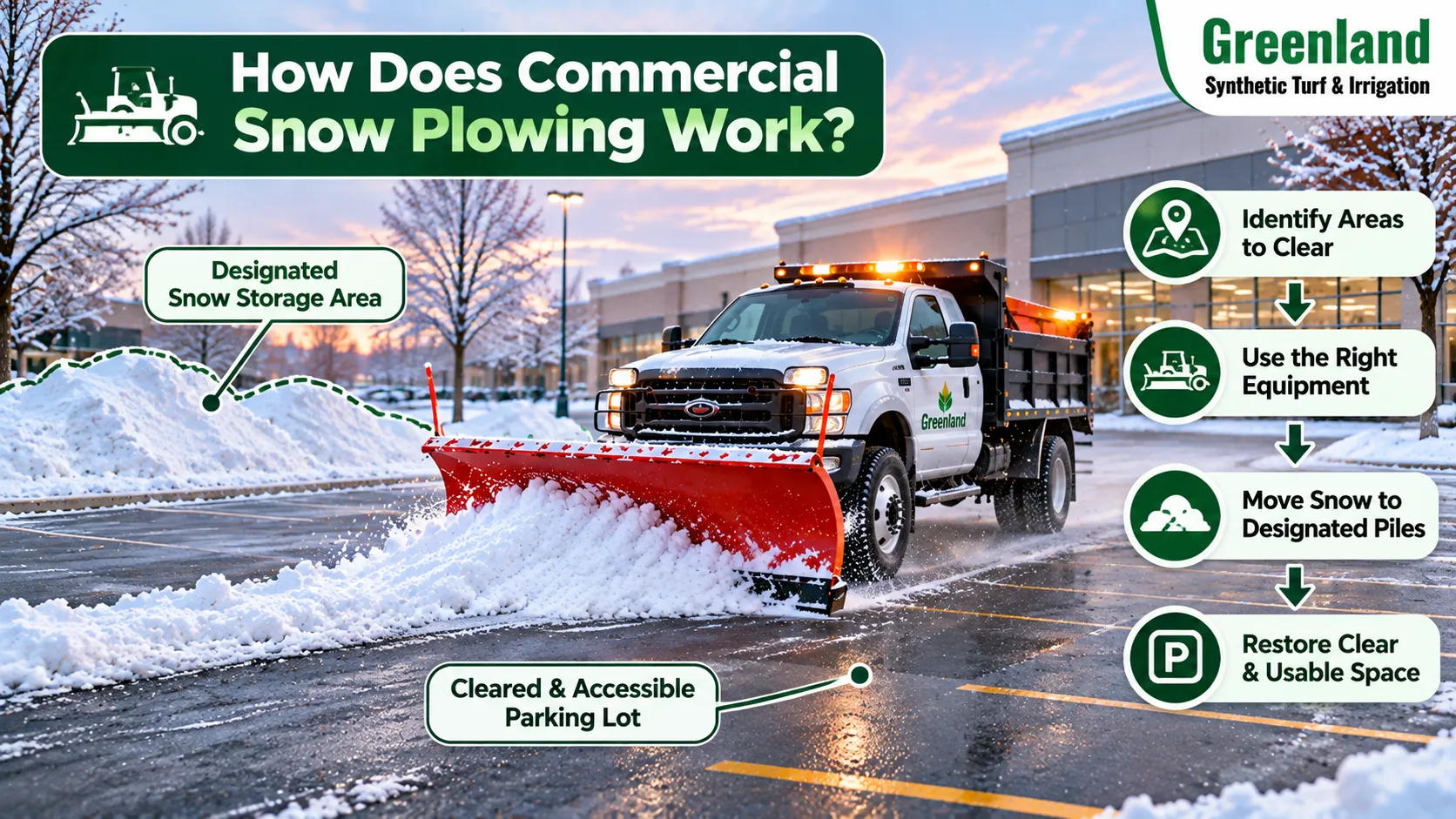
How Does Commercial Snow Plowing Work?
The process typically begins with identifying the areas that need clearing and determining where the accumulated snow can be placed.
Depending on the property’s layout and snow conditions, contractors may use plow-equipped trucks, loaders or other suitable equipment.
Snow is pushed away from active parking and driving areas into designated piles or storage zones. The placement of these piles matters because poorly positioned snow can obstruct visibility, reduce parking capacity or restrict vehicle movement.
Example: A retail plaza receives significant snowfall overnight. A contractor plows the parking lot and moves the snow towards designated perimeter areas, restoring space for vehicles and customers.
The snow remains on the property, but the active surfaces become more accessible.
What Is Snow Hauling?
Snow hauling is the process of collecting accumulated snow, loading it onto trucks and transporting it away from the property to an appropriate designated disposal or storage location.
Unlike regular plowing, which generally relocates snow within the site, hauling removes the accumulated piles from the property.
This service is particularly useful when available snow storage space becomes limited or when snow piles interfere with parking, access, visibility or property operations.
How Do Snow Hauling Services Work?
Snow hauling usually involves several steps:
- Snow collection: Accumulated piles are gathered from designated areas using appropriate equipment.
- Loading: Snow is loaded into suitable trucks or hauling equipment.
- Transportation: The collected snow is transported away from the property.
- Site clearance: The designated storage or parking areas are cleared of the accumulated piles.
The exact process depends on the property, snow volume, equipment requirements and available disposal arrangements.
Example: A commercial parking lot has received repeated snowfall over several weeks. Although regular plowing has maintained the main driving lanes, large snow piles are taking up several parking spaces. The property manager arranges snow hauling to remove those piles and recover the lost space.
Snow Plowing vs. Snow Hauling: Key Differences
Both services help manage winter accumulation, but their purpose and application are different.
| Comparison | Snow Plowing | Snow Hauling |
|---|---|---|
| Main purpose | Clear snow from active surfaces | Remove accumulated snow from the property |
| Snow destination | Designated on-site storage areas | Off-site location |
| Equipment | Plow trucks, loaders and other clearing equipment | Loaders, trucks and hauling equipment |
| Parking capacity | Restores access but may leave snow piles occupying space | Can recover space used by accumulated piles |
| Typical use | Routine snowfall and property clearing | Large piles and limited storage capacity |
| Cost considerations | Depends on area, accumulation and service scope | Also depends on loading, hauling distance and disposal arrangements |
The two services are not necessarily alternatives. Many commercial properties use regular plowing throughout winter and arrange snow hauling when on-site storage becomes insufficient.
When Is Snow Plowing Enough for Your Commercial Property?
For many commercial properties, snow plowing is sufficient when there is enough designated space to store accumulated snow without interfering with normal operations.
It may be suitable when:
- Parking areas have sufficient perimeter storage space.
- Snow piles do not obstruct entrances or vehicle routes.
- Available parking capacity remains adequate.
- Visibility at intersections and access points is maintained.
- Snow storage locations do not create recurring drainage or access problems.
For example, a commercial property with a large parking lot and suitable perimeter space may be able to manage most snowfall through routine plowing.
However, property managers should review storage locations as the season progresses. A plan that works after the first snowfall may become less practical after repeated storms.
When Does Your Property Need Snow Hauling?
Snow hauling becomes more relevant when accumulated snow can no longer be stored conveniently on-site.
There are several situations where commercial snow removal may require hauling in addition to plowing.
1. Snow Piles Are Taking Up Parking Spaces
Repeated plowing can gradually move snow into storage areas around the parking lot. As piles grow, they may occupy spaces that customers, employees or residents need.
Hauling can remove the accumulated piles and help restore usable parking capacity.
2. Snow Is Restricting Vehicle Movement
Large piles can narrow drive lanes, reduce turning space and obstruct access around entrances or loading areas.
This can become particularly challenging for industrial properties that accommodate delivery trucks and heavy vehicles.
3. On-Site Storage Space Is Limited
Some commercial properties simply do not have enough space to store repeated snowfall throughout the season.
When designated storage areas become full, off-site snow hauling may be needed to maintain usable outdoor space.
4. Visibility Is Being Obstructed
Snow piles near intersections, driveways and entrances can affect sightlines for drivers and pedestrians.
Relocating or hauling accumulated snow may help address these obstructions, depending on the property layout.
5. Snow Storage Is Creating Drainage Concerns
Large piles can affect where meltwater flows during temperature changes. Poorly selected storage locations may contribute to water collecting in areas where it can later refreeze.
Property managers should review storage locations and drainage conditions rather than allowing piles to grow without a plan.
Snow Relocation vs. Snow Hauling: Are They the Same?
These terms are related but do not always describe the same service.
Snow relocation generally means moving accumulated snow from one part of a property to another. For example, snow may be moved away from a parking area towards a designated storage zone.
Snow hauling generally involves loading snow and transporting it off-site.
A property may need relocation when snow piles are blocking an important area but there is still suitable storage space elsewhere on the site. Hauling becomes more relevant when on-site storage is insufficient or the accumulated piles need to be removed entirely.
Before arranging either service, property managers should confirm the contractor’s definition of the service and whether equipment, transportation and disposal costs are included.
What Affects Commercial Snow Hauling Costs?
Snow hauling usually involves more work than routine plowing because accumulated snow must be collected, loaded and transported.
The overall cost may depend on:
- Snow volume: Larger piles require more loading and transportation.
- Property layout: Restricted access or limited working space may affect equipment requirements.
- Equipment and labour: The machinery and resources required depend on the size and condition of the piles.
- Hauling distance: Transportation distance can influence the overall cost.
- Disposal arrangements: The availability and requirements of an appropriate snow disposal location may affect pricing.
- Timing and access: Operational restrictions and the time available to complete the work may influence the service arrangement.
When requesting a quote, ask whether the price includes collection, loading, transportation and disposal. This helps prevent confusion about what the snow hauling service actually covers.
How to Choose the Right Winter Snow Removal Plan
The right approach depends on your property’s size, parking requirements, available storage space and winter operating conditions.
Before selecting a winter maintenance arrangement, consider these questions:
- How much snow storage space is available?
- Will snow piles reduce parking capacity during the season?
- Are there important entrances or truck routes that need additional space?
- Does the property experience recurring visibility or drainage concerns?
- Are snow relocation or off-site hauling included in the agreement?
- How are additional hauling visits priced?
- Who approves and coordinates additional snow removal work?
A practical winter maintenance plan should account for both routine snowfall and the possibility that accumulated snow will eventually need to be removed.
For commercial properties, the objective is not simply to clear snow after each storm. It is to manage accumulation in a way that reflects the property’s operational requirements throughout winter.
Commercial Snow Plowing and Snow Removal with Greenland Irrigation
Commercial properties need winter maintenance plans that consider parking availability, vehicle access, snow storage and changing weather conditions.
Greenland Irrigation provides winter maintenance services for applicable commercial, industrial and multi-residential properties, with service details confirmed according to each property’s requirements and agreement.
If you manage a property that needs regular snow clearing, explore our commercial snow plowing services.
You can also review our snow and ice removal services to discuss broader winter maintenance requirements.
Before arranging snow relocation or hauling, confirm the available services, off-site arrangements and associated charges with the provider.
Frequently Asked Questions
1. What is the difference between snow plowing and snow hauling?
Snow plowing pushes accumulated snow away from parking lots, driveways and other active surfaces, usually into designated on-site storage areas. Snow hauling involves loading accumulated snow and transporting it away from the property.
2. When does a commercial property need snow hauling?
Snow hauling may be necessary when snow piles reduce parking capacity, obstruct vehicle access, affect visibility or exceed the property’s available storage space.
3. Is snow relocation the same as snow hauling?
No. Snow relocation generally means moving snow to another area within the property, while snow hauling involves transporting accumulated snow off-site.
4. Does commercial snow removal include snow hauling?
Not necessarily. Some agreements include only routine snow plowing, while relocation and off-site hauling may be offered separately or charged additionally. Confirm the service scope before signing a contract.
5. What factors affect snow hauling costs?
Costs may depend on snow volume, equipment requirements, labour, property access, transportation distance and disposal arrangements. Ask for a breakdown of what is included in the quote.
6. Can snow plowing and snow hauling be arranged under one winter maintenance plan?
They may be combined, depending on the provider’s services and agreement. Routine plowing can manage new snowfall, while additional hauling can be arranged when on-site snow storage becomes insufficient.