
Where Should Snow Be Piled in a Commercial Parking Lot? A Property Manager’s Guide
When snow starts accumulating in a commercial parking lot, clearing the driving lanes and parking spaces is only half the job. The other challenge is deciding where all that snow should go.
Poor snow pile placement can reduce available parking, block entrances, obstruct visibility, interfere with drainage, and create hazards for pedestrians and vehicles. As snowfall continues throughout an Ontario winter, these problems can become increasingly difficult to manage.
That is why commercial parking lot snow storage should be part of every property’s winter maintenance plan. Designating suitable snow storage areas before the first major snowfall helps property managers maintain safer access, preserve parking capacity, and avoid unnecessary snow relocation.
So, where should snow be piled in a commercial parking lot? Let’s look at the key considerations.
Why Does Snow Pile Placement Matter in Commercial Parking Lots?
Snow piles take up more space than many property managers initially expect. A pile that seems manageable after one snowfall can become a significant obstruction after several storms.
The location of accumulated snow affects more than the appearance of a property. It can influence:
- Parking capacity: Large piles can occupy spaces needed by customers, employees, and visitors.
- Traffic visibility: Snowbanks near intersections and exits can obstruct drivers’ views of approaching vehicles and pedestrians.
- Pedestrian access: Poorly placed piles can block sidewalks, accessible routes, and building entrances.
- Drainage: Snow stored over catch basins or drainage channels can interfere with water movement during thawing.
- Business operations: Blocked loading areas, fire access routes, and delivery paths can disrupt daily activities.
A well-planned snow storage layout helps prevent these issues before they develop.
7 Factors to Consider When Choosing Snow Storage Areas
Not every open space in a parking lot is suitable for snow storage. Before assigning designated piling zones, property managers should evaluate the layout, traffic patterns, drainage, and operational requirements of the site.
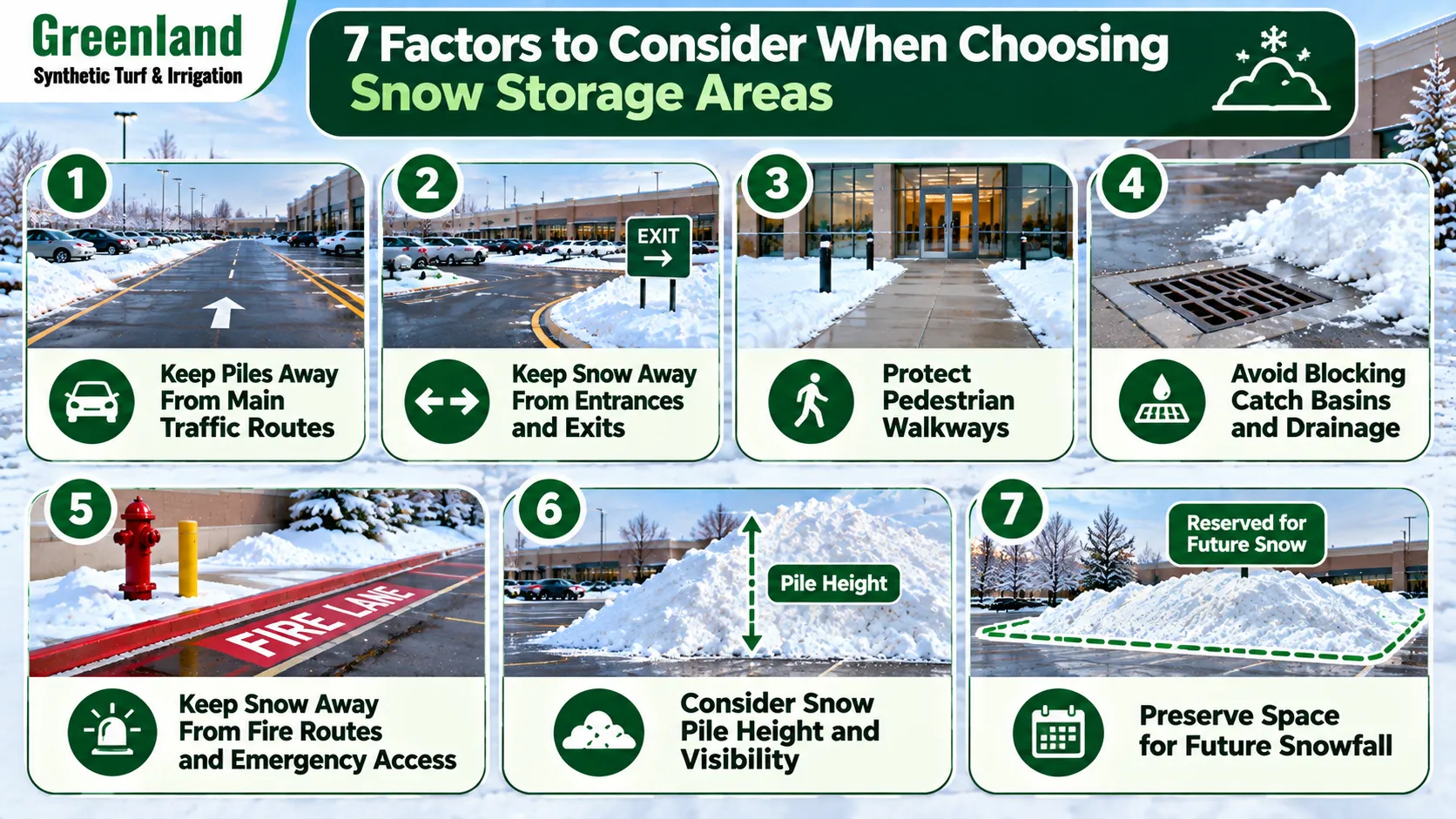
1. Choose Areas Away From Main Traffic Routes
Snow piles should generally be positioned away from primary driving lanes, turning areas, and vehicle circulation routes.
Placing snow along the edges of suitable parking lot sections may help keep the main travel paths clear. However, the selected areas should not reduce the space needed for vehicles to manoeuvre safely.
Consider:
- Main entrances and exits
- Internal driving lanes
- Turning areas and intersections
- Access routes between parking sections
- Areas frequently used by delivery and service vehicles
The goal is to create enough room for snow accumulation without compromising the movement of vehicles.
2. Keep Snow Away From Entrances and Exit Points
Entrances and exits require clear sightlines. Snowbanks placed too close to these areas can make it harder for drivers to see pedestrians, cyclists, and approaching traffic.
Avoid using entrance corners, exit approaches, and visibility triangles as snow storage locations.
Property managers should also consider how snow accumulation might change throughout the winter. A small pile near an entrance can grow into a much larger obstruction after repeated clearing operations.
3. Protect Pedestrian Walkways and Accessible Routes
Commercial properties need safe pedestrian access even during heavy snowfall.
Snow should not be piled where it can block:
- Main building entrances
- Sidewalks and pedestrian crossings
- Accessible parking spaces and access aisles
- Curb ramps and accessible routes
- Walkways connecting parking areas to buildings
Designated snow storage areas should be separated from pedestrian movement wherever practical. This helps reduce the risk of pedestrians having to walk around snowbanks and into vehicle traffic.
For additional winter safety considerations, see our guide to de-icing and sidewalk clearing.
4. Avoid Blocking Catch Basins and Drainage Systems
Drainage is one of the most important considerations when planning snow storage.
Snow piles gradually melt as temperatures rise. The resulting water needs a clear path to reach the property’s drainage system.
If snow is piled directly over catch basins or drainage channels, melting water may not drain as intended. During freeze-thaw cycles, standing water can also refreeze and create slippery conditions.
When selecting storage areas:
- Keep catch basins and drainage openings accessible.
- Avoid blocking known drainage channels.
- Consider the natural slope of the parking lot.
- Monitor areas where melting water tends to collect.
- Check drainage access during and after major snow events.
A snow storage plan should account for both winter accumulation and spring meltwater.
5. Keep Snow Away From Fire Routes and Emergency Access
Emergency access must remain available throughout the winter.
Snow piles should never obstruct designated fire routes, emergency vehicle access, fire hydrants, or other critical safety infrastructure.
Property managers should identify these areas before the season begins and clearly communicate them to snow removal crews.
Even when a parking lot has plenty of unused space, emergency access areas should not be treated as convenient snow storage locations.
6. Consider Snow Pile Height and Visibility
The amount of snow stored in an area matters just as much as its location.
As piles grow, they can restrict sightlines around corners, intersections, pedestrian crossings, and parking lot exits. Tall snowbanks may also make it harder for drivers to identify vehicles or pedestrians approaching from the other side.
Property managers should:
- Monitor snowbank growth throughout the season.
- Keep sightlines clear at intersections and exits.
- Avoid allowing piles to encroach on pedestrian routes.
- Reassess storage areas after repeated snowfall.
- Arrange relocation when piles become operational or safety concerns.
There is no single suitable snow pile height for every property. The appropriate limit depends on the site’s layout, visibility requirements, local conditions, and applicable safety considerations.
7. Preserve Space for Future Snowfall
One of the most common snow management mistakes is using all available storage space after the first few storms.
Ontario winters can bring repeated snowfall. A storage area that becomes full early in the season leaves fewer practical options for later storms.
A better approach is to plan for the entire winter rather than a single snowfall.
Estimate how much space may be required based on:
- Parking lot size and layout
- Typical winter snowfall conditions
- Available storage zones
- Frequency of snow clearing
- Areas where snow can safely be relocated
- Whether off-site hauling may eventually be necessary
Leaving room for future accumulation can reduce the likelihood of emergency snow relocation later in the season.
Where Should You Avoid Piling Snow?
Some locations may appear convenient during snow clearing but can create significant problems as piles grow.
| Avoid piling snow near | Why it creates problems |
|---|---|
| Main entrances and exits | Can obstruct visibility and vehicle movement |
| Fire routes and hydrants | May interfere with emergency access |
| Accessible parking spaces | Can restrict access and accessible routes |
| Sidewalks and pedestrian crossings | Forces pedestrians into unsafe paths |
| Catch basins and drains | Can interfere with meltwater drainage |
| Loading docks | Can disrupt deliveries and operations |
| Intersections and turning areas | Reduces visibility and manoeuvring space |
| Building ventilation or service areas | May obstruct equipment access or operations |
The exact restrictions depend on the property’s layout and applicable requirements. Property managers should identify sensitive areas during their pre-winter inspection.
What Happens When a Commercial Parking Lot Runs Out of Snow Storage Space?
Even a well-designed parking lot can run out of practical snow storage capacity during a winter with repeated or heavy snowfall.
When piles begin occupying essential areas, property managers may need to consider additional snow management options.
Snow Relocation Within the Property
Snow relocation involves moving accumulated snow from one part of a property to another suitable storage area.
This may be an option when:
- Existing piles are blocking parking spaces.
- Snowbanks are affecting visibility.
- Access routes are becoming restricted.
- A designated storage area still has available capacity.
However, relocation only works when a suitable alternative area exists.
Off-Site Snow Hauling
When on-site storage becomes insufficient, off-site snow hauling may be considered.
This involves loading accumulated snow and transporting it away from the property to an appropriate disposal or receiving location.
Snow hauling can help restore parking capacity and remove large snow piles that cannot be accommodated safely on-site. It is important to confirm the availability, scope, costs, and disposal arrangements with the service provider before relying on it.
For a closer look at the differences, read our guide to snow plowing vs. snow hauling.
How to Create a Commercial Parking Lot Snow Storage Plan
A practical snow storage plan does not need to be complicated. It should clearly identify where snow can be piled, which areas must remain accessible, and what happens when designated storage zones become full.
Property managers can use the following checklist before winter begins.
Pre-Winter Snow Storage Checklist
-
Review the parking lot layout and identify potential snow storage areas.
-
Mark primary driving lanes, entrances, and exits.
-
Identify fire routes, hydrants, and emergency access points.
-
Protect accessible parking spaces and pedestrian routes.
-
Locate catch basins and drainage channels.
-
Check visibility around intersections and corners.
-
Estimate available snow storage capacity.
-
Identify alternative locations for snow relocation.
-
Determine when off-site hauling may be required.
-
Share the storage plan with the snow removal provider.
The plan should be reviewed during the winter as conditions change. Snow storage areas may need to be adjusted as piles grow or operational requirements shift.
Commercial Snow Plowing and Snow Storage Planning in London, Ontario
Commercial properties in London, Ontario, need a winter maintenance approach that accounts for more than clearing fresh snowfall. Parking availability, pedestrian access, drainage, visibility, and snow storage capacity all influence how effectively a property can be maintained.
Greenland Irrigation provides winter maintenance services for commercial and industrial properties, including commercial snow plowing and industrial snow plowing.
For property managers, discussing snow storage locations before winter begins can help establish clearer expectations about where snow should be placed and how the property should be managed as accumulation increases.
A suitable plan should consider the property’s layout, operational needs, designated storage areas, and the possibility that additional snow relocation or hauling may become necessary.
Final Thoughts: Plan Snow Storage Before the First Major Snowfall
Deciding where to pile snow in a commercial parking lot is an important part of winter property management.
Poorly positioned snowbanks can reduce parking capacity, block pedestrian routes, interfere with drainage, and create visibility problems. By identifying suitable storage areas in advance, property managers can make snow clearing more organised and help maintain access throughout the winter.
The best time to plan snow storage is before snowfall begins. Review your parking lot layout, identify restricted areas, preserve space for future storms, and discuss the plan with your commercial snow removal provider.
Need a winter maintenance plan for your commercial property in London, Ontario? Contact Greenland Irrigation to discuss your commercial snow plowing requirements and winter property maintenance needs.
Frequently Asked Questions About Commercial Parking Lot Snow Storage
1. Where should snow be piled in a commercial parking lot?
Snow should generally be piled in designated areas away from main traffic lanes, entrances, exits, pedestrian walkways, accessible parking spaces, fire routes, hydrants, and drainage systems. The ideal locations depend on the property’s layout and available storage capacity.
2. Why is snow pile placement important?
Snow pile placement affects parking capacity, vehicle visibility, pedestrian access, drainage, and daily business operations. Poorly positioned snowbanks can create obstructions and additional winter safety concerns.
3. Can snow be piled over catch basins?
Snow should not be stored directly over catch basins or drainage openings. Keeping these areas accessible helps melting snow reach the drainage system and reduces the risk of water accumulation and refreezing.
4. What should businesses do when a parking lot runs out of snow storage space?
Businesses can assess whether snow can be relocated to another suitable on-site area. If on-site capacity is exhausted, off-site snow hauling may be considered, subject to suitable arrangements and provider availability.
5. How can property managers plan snow storage before winter?
Property managers should review the parking lot layout, identify designated storage zones, protect emergency and pedestrian access, locate drainage infrastructure, estimate storage capacity, and discuss snow relocation options with their snow removal provider.