
Why Does a Parking Lot Freeze Again After Snow Has Been Cleared? 7 Causes Property Managers Should Know
A commercial parking lot may look completely clear after snow plowing, but a few hours later, slippery patches can appear across the surface. Water begins to freeze, vehicle tyres lose traction, and pedestrians encounter unexpected icy areas.
Why does this happen?
Snow removal clears accumulated snow, but it does not necessarily eliminate every source of moisture or prevent ice from forming again. Temperature changes, residual snow, melting water, poor drainage, and inadequate ice control can all contribute to refreezing.
For commercial property managers in London, Ontario, understanding why parking lots freeze after snow removal is an important part of maintaining safer winter conditions. A parking lot needs more than a single clearing operation. It requires ongoing attention to changing weather and surface conditions.
Let’s explore the seven common reasons parking lots freeze again after snow has been cleared and what property managers can do about them.
7 Reasons Parking Lots Freeze Again After Snow Removal
Refreezing can happen even when a snow removal operation has been completed properly. The following factors explain why previously cleared surfaces may become slippery again.
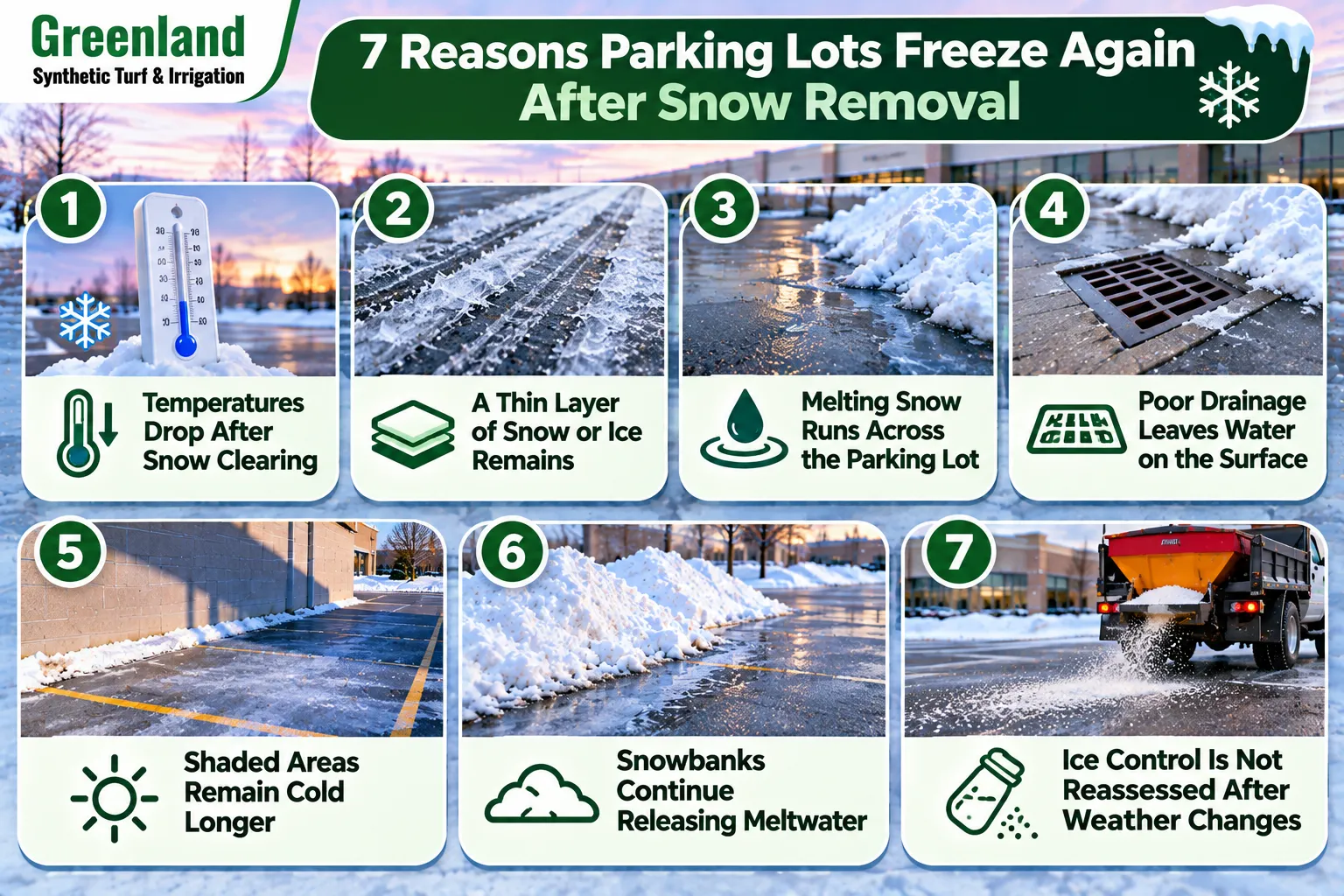
1. Temperatures Drop After Snow Clearing
One of the most common reasons for refreezing is a sudden temperature drop.
During the day, sunlight and relatively warmer temperatures can melt remaining snow and ice. The resulting water spreads across the parking lot surface. When temperatures fall below freezing in the evening or overnight, that moisture can turn into ice.
This is particularly concerning during Ontario’s freeze-thaw cycles, when temperatures fluctuate around the freezing point.
For example:
- Snow is cleared during the afternoon.
- Remaining snow and ice begin to melt.
- Water spreads across pavement and low-lying areas.
- Temperatures drop overnight.
- The moisture freezes, creating slippery patches.
This is why a parking lot that looks safe during the afternoon may become hazardous later.
What property managers can do: Monitor weather forecasts and arrange follow-up inspections when temperatures are expected to fall after melting conditions.
2. A Thin Layer of Snow or Ice Remains After Plowing
Snow plowing removes accumulated snow, but it may leave a thin layer of compacted snow or ice on the pavement.
Vehicle traffic can compress this material further, making it harder to remove. As temperatures fluctuate, the remaining layer can become wet and refreeze.
This can create a slippery surface that is difficult to identify, especially when the pavement appears mostly clear.
Areas that deserve particular attention include:
- Parking spaces with frequent vehicle movement
- Main entrances and exits
- Turning areas
- Loading zones
- Areas where snow tends to become compacted
What property managers can do: Include a surface-condition inspection after snow clearing. Where necessary, additional ice treatment or mechanical removal may be required.
3. Melting Snow Runs Across the Parking Lot
Snow does not always melt where it was originally piled.
As temperatures rise, meltwater can flow from snowbanks across driving lanes, parking spaces, sidewalks, and pedestrian crossings. If this water is not properly drained before temperatures fall, it can freeze again.
This is a common concern around:
- Snow storage areas
- Parking lot edges
- Building entrances
- Sloped surfaces
- Areas where water naturally collects
The problem can become more serious when snow piles are positioned near important pedestrian or vehicle routes.
What property managers can do: Review snow storage locations and monitor where meltwater travels. Keep drainage paths clear and address recurring water accumulation areas.
4. Poor Drainage Leaves Water on the Surface
Parking lots need effective drainage to prevent water from collecting on the pavement.
If catch basins are blocked by snow, ice, or debris, melting water may remain on the surface instead of draining away. Low spots, uneven pavement, and damaged drainage areas can also contribute to standing water.
When temperatures drop, this water can freeze into slippery patches.
Property managers should pay particular attention to:
- Depressions in the pavement
- Areas near catch basins
- Parking lot corners
- Sloped entrances
- Locations with a history of standing water
What property managers can do: Keep drainage openings accessible, inspect recurring problem areas, and arrange repairs where drainage issues are contributing to repeated ice formation.
5. Shaded Areas Remain Cold Longer
Not every part of a commercial parking lot receives the same amount of sunlight.
Areas shaded by buildings, trees, structures, or other obstacles may remain colder than surrounding pavement. Snow and moisture in these locations can take longer to melt and may freeze again sooner.
This can create inconsistent surface conditions across the same property. One section of a parking lot may appear dry while another remains icy.
Common shaded locations include:
- Areas beside large buildings
- Covered parking sections
- North-facing spaces
- Areas beneath trees
- Narrow walkways between structures
What property managers can do: Identify shaded sections during winter inspections and include them in regular ice monitoring rather than assuming the entire parking lot has similar conditions.
6. Snowbanks Continue Releasing Meltwater
Large snow piles can remain on commercial properties long after the main parking area has been cleared.
When temperatures rise, these piles release water gradually. The meltwater can spread into nearby parking spaces, access routes, and pedestrian areas.
If the temperature drops again, the water can freeze and create black ice or other slippery patches.
The risk is greater when snowbanks are located near:
- Building entrances
- Sidewalks
- Parking lot intersections
- Drainage openings
- Vehicle turning areas
What property managers can do: Monitor snowbanks throughout the winter and assess whether accumulated snow needs to be relocated. Ensure meltwater has a suitable drainage path.
7. Ice Control Is Not Reassessed After Weather Changes
Ice control is not always a one-time activity.
A treatment applied during one set of weather conditions may not provide the same level of protection when temperatures, precipitation, or surface conditions change.
For example, melting snow followed by freezing rain or a sharp temperature drop can create new ice even after an earlier treatment.
The effectiveness of de-icing materials also depends on factors such as:
- Pavement temperature
- Type and amount of ice
- Weather conditions
- Application rate
- Product specifications
- Surface characteristics
Simply applying more material is not always the right solution. Treatment decisions should be based on actual conditions and the product’s recommended use.
What property managers can do: Reassess surface conditions after weather changes and arrange additional ice management where required.
What Is Black Ice, and Why Is It Dangerous in Parking Lots?
Black ice is a thin, often transparent layer of ice that forms on a surface. It can be difficult to notice because the pavement underneath remains visible.
This makes black ice particularly concerning in commercial parking lots. Drivers and pedestrians may not recognise the icy surface until they begin to slip or lose traction.
Black ice can develop when:
- Meltwater freezes overnight.
- Light rain falls on cold pavement.
- Water from snowbanks runs across driving lanes.
- Residual moisture freezes after a temperature drop.
- Previously wet surfaces cool below freezing.
Property managers should pay special attention to shaded areas, entrances, slopes, pedestrian crossings, and locations where water regularly accumulates.
Regular inspections and timely ice management can help identify these conditions before they create more serious problems.
Snow Removal vs. Ice Management: Why Both Are Necessary
Snow removal and ice management address different winter maintenance problems.
| Snow removal | Ice management |
|---|---|
| Removes accumulated snow from surfaces | Addresses slippery ice and freezing conditions |
| Uses plows and other snow-clearing equipment | May involve de-icing treatments and mechanical ice removal |
| Restores access to parking and driving areas | Helps manage traction and surface safety |
| Focuses on snow accumulation | Focuses on existing ice and conditions that can create ice |
A parking lot can be clear of visible snow and still present a slipping hazard.
That is why commercial properties should consider snow clearing and ice management as connected parts of a broader winter maintenance plan.
Explore commercial snow and ice removal services to understand how snow clearing fits into overall winter property maintenance.
How Can Property Managers Reduce Refreezing in Commercial Parking Lots?
Although changing weather cannot be controlled, property managers can take practical steps to reduce recurring ice problems.
Create a Weather Monitoring Routine
Track temperature changes, snowfall, freezing rain, and expected thaw periods. Pay particular attention to conditions when daytime melting is followed by overnight freezing.
Inspect High-Risk Areas
Do not rely only on a general visual check of the parking lot. Inspect entrances, exits, shaded areas, slopes, sidewalks, and locations where water collects.
Keep Drainage Systems Accessible
Ensure catch basins and drainage openings are not covered by snow or obstructed by debris. Investigate recurring standing water rather than repeatedly treating the resulting ice.
Manage Snow Storage Properly
Snow piles should be positioned away from critical access routes and drainage infrastructure wherever practical. Monitor them for meltwater that could flow back onto cleared surfaces.
Arrange Follow-Up Ice Control
A parking lot may need additional attention after snow clearing, particularly when temperatures change or new precipitation occurs. Follow-up inspections help determine whether additional treatment is necessary.
Maintain Pedestrian Routes
Parking lot maintenance should include sidewalks, entrances, accessible routes, and pedestrian crossings. These areas can become slippery even when the main vehicle lanes are clear.
For more information, see our de-icing and sidewalk clearing services.
Why Commercial Properties in London, Ontario Need Ongoing Ice Management
Commercial properties in London, Ontario, can experience changing winter conditions that make ice management an ongoing responsibility.
A parking lot may go through several stages within a short period: snowfall, plowing, melting, refreezing, and additional accumulation. Each stage can create different maintenance requirements.
For property managers, this means winter maintenance planning should account for more than the initial snowfall response.
Greenland Irrigation offers winter maintenance services for commercial and industrial properties, including commercial snow plowing and industrial snow plowing.
Combining an appropriate snow-clearing plan with attention to de-icing, pedestrian access, drainage, and changing weather conditions can help businesses manage winter property challenges more effectively.
Frequently Asked Questions About Parking Lot Refreezing
1. Why does my parking lot freeze again after snow removal?
A parking lot can freeze again because melting snow, residual moisture, compacted ice, and water from snowbanks may remain on the surface. When temperatures fall below freezing, this moisture can turn into ice even after the snow has been cleared.
2. How soon can a parking lot refreeze after snow plowing?
Refreezing can happen as soon as surface temperatures fall below freezing while moisture remains on the pavement. The timing depends on air and pavement temperatures, sunlight, wind, drainage, and the amount of moisture present.
3. What causes black ice in commercial parking lots?
Black ice can form when meltwater, rain, or residual moisture freezes into a thin, transparent layer. It commonly develops in shaded areas, near snowbanks, on slopes, and in locations where water collects.
4. Does snow plowing prevent ice from forming?
No. Snow plowing removes accumulated snow but does not necessarily remove all moisture or prevent future ice formation. Additional inspections and appropriate ice management may be needed as weather conditions change.
5. Why do parking lots freeze near snow piles?
Snow piles release meltwater as temperatures rise. If that water flows onto nearby pavement and temperatures subsequently drop, it can freeze and create slippery areas around the snow storage zone.
6. How can businesses prevent parking lot refreezing?
Businesses can reduce refreezing risks by monitoring weather conditions, inspecting high-risk areas, maintaining clear drainage paths, managing snow storage, and arranging appropriate follow-up ice control after changing weather conditions.
Final Thoughts: Clearing Snow Is Only the First Step
A cleared parking lot is not necessarily an ice-free parking lot.
Residual snow, melting water, poor drainage, shaded areas, and changing temperatures can all cause surfaces to freeze again after snow removal. Without ongoing monitoring, these conditions can create unexpected hazards for customers, employees, and visitors.
For commercial property managers, the most effective approach is to treat snow clearing and ice management as connected responsibilities. Plan for changing weather, inspect problem areas, maintain drainage, and address icy conditions when they develop.
Need help managing snow and ice on your commercial property in London, Ontario? Contact Greenland Irrigation to discuss your commercial winter maintenance and snow-clearing requirements.