
Is Your Commercial Property Winter-Ready? 10 Things Every Winter Maintenance Plan Should Include
The first snowfall is not the time to start thinking about winter property maintenance.
For commercial property owners and managers in London, Ontario, preparing for winter means looking beyond snow removal. Parking lots, sidewalks, building entrances, drainage systems, emergency access routes, and outdoor infrastructure all need attention before freezing temperatures and repeated snowfall create problems.
A property that looks perfectly maintained in autumn can quickly become difficult to manage when snow accumulates, ice forms overnight, and temperatures fluctuate.
That’s why having a well-organised winter property maintenance plan matters. It helps businesses prepare for seasonal challenges, coordinate maintenance responsibilities, and keep essential areas accessible throughout the winter.
But what should such a plan actually include?
Here are 10 important elements every commercial property manager should consider before winter arrives.
Why Does Your Commercial Property Need a Winter Maintenance Plan?
Winter conditions can affect almost every part of a commercial property.
A parking lot may become difficult to navigate after heavy snowfall. Meltwater can freeze near building entrances. Snowbanks can block visibility, while neglected drainage areas may contribute to standing water and ice formation.
Without a clear maintenance strategy, property managers may find themselves reacting to problems instead of preparing for them.
A winter maintenance plan helps businesses:
- Maintain access to parking areas, entrances, and walkways.
- Identify potential snow and ice hazards.
- Organise snow clearing and ice management responsibilities.
- Protect drainage systems and outdoor infrastructure.
- Reduce disruptions to employees, customers, and deliveries.
- Plan maintenance resources and service requirements in advance.
Most importantly, it gives everyone involved a clearer understanding of what needs to be maintained and how changing winter conditions will be handled.
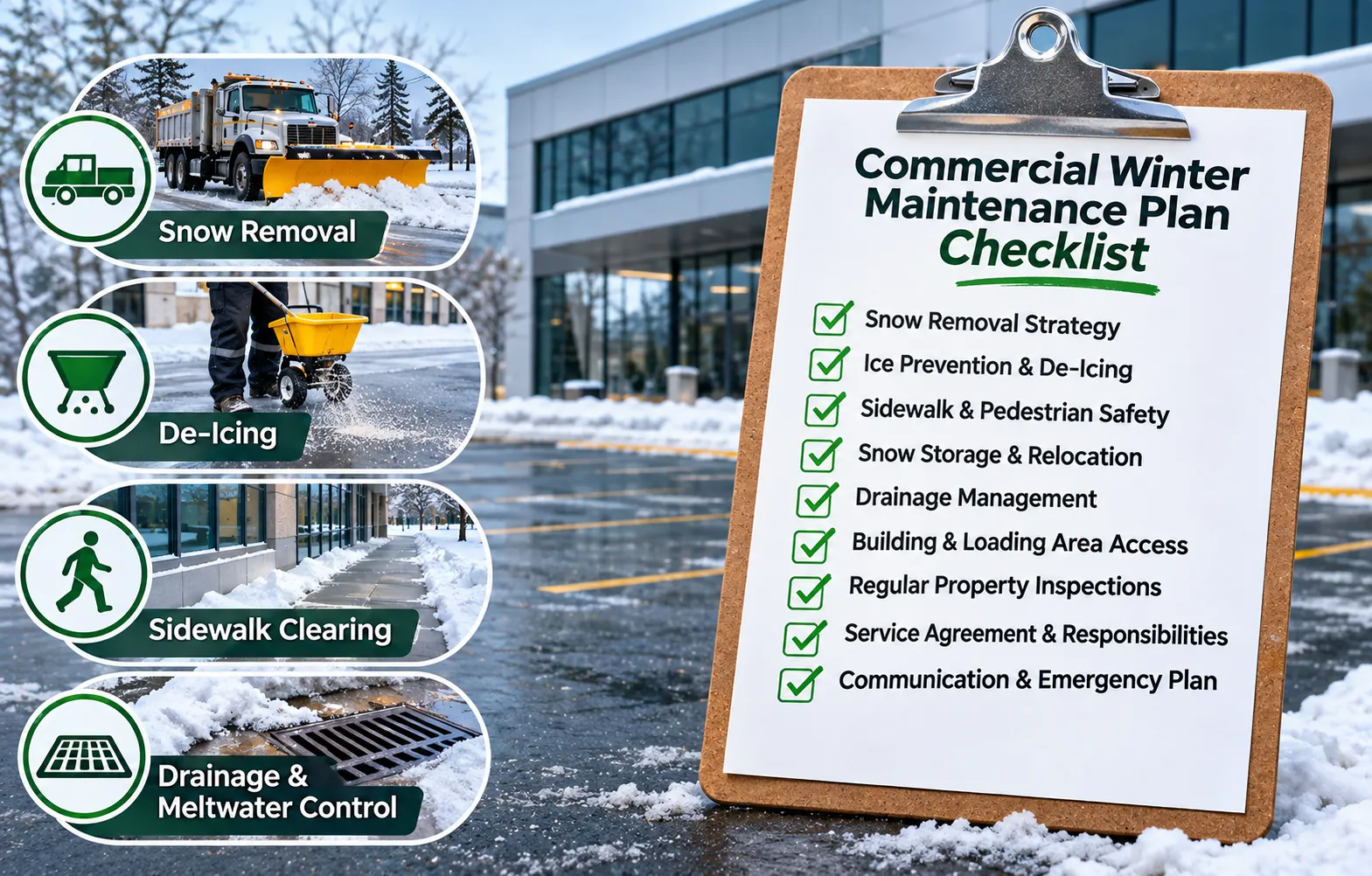
10 Things Every Commercial Winter Property Maintenance Plan Should Include
A useful winter maintenance plan should cover the entire property, not just the areas where snow is most visible.
Here are the key elements to include.
1. A Commercial Snow Removal Strategy
Snow accumulation is one of the biggest challenges for commercial properties during winter.
Parking lots, driveways, internal roads, loading areas, and vehicle access routes need a clearly defined snow removal strategy. Simply waiting until snow becomes difficult to navigate can create unnecessary operational problems.
Before winter begins, identify:
- Main entrances and exits.
- Primary vehicle circulation routes.
- Employee and visitor parking areas.
- Loading docks and delivery access points.
- Emergency vehicle access routes.
- Areas where snow can be safely stored.
Your plan should also clarify who is responsible for snow clearing, which areas receive priority, and how service requirements are communicated.
For properties with larger parking areas or complex layouts, a coordinated commercial snow plowing service can form an important part of the winter maintenance strategy.
2. An Ice Prevention and De-Icing Plan
Snow removal alone does not guarantee that a property will remain safe.
Even after snow has been cleared, moisture can remain on pavement and freeze when temperatures fall. This can create slippery surfaces around parking spaces, entrances, ramps, and pedestrian routes.
A winter maintenance plan should identify areas where ice is most likely to develop and establish how these locations will be monitored.
Consider including:
- Building entrances and exit areas.
- Sloped driveways and ramps.
- Parking lot intersections.
- Pedestrian crossings.
- Shaded areas that remain cold longer.
- Locations where water regularly collects.
Depending on the conditions, suitable ice management may involve mechanical removal, de-icing treatments, or other appropriate measures.
Explore de-icing and sidewalk clearing services as part of a broader approach to winter surface maintenance.
3. Safe and Accessible Sidewalks and Pedestrian Routes
Commercial properties need to accommodate more than vehicles.
Employees, customers, visitors, delivery personnel, and contractors all need safe routes between parking areas and buildings.
Sidewalks can become slippery when snow is compacted under foot traffic or when melting water freezes again. Snowbanks can also obstruct walkways and accessible routes.
Your maintenance plan should identify:
- Main pedestrian walkways.
- Building entrances.
- Sidewalk connections to parking areas.
- Accessible parking spaces and access aisles.
- Curb ramps and crossing points.
- Outdoor stairways and ramps.
These areas should be included in winter inspections rather than treated as secondary tasks after parking lot snow clearing.
4. A Snow Storage and Relocation Strategy
Where will all the cleared snow go?
This is a question many commercial property managers overlook until available space starts running out.
Poor snow pile placement can reduce parking capacity, obstruct visibility, block drainage, and interfere with vehicle movement.
Your winter property maintenance plan should identify suitable snow storage locations before the first major snowfall.
Evaluate:
- Available space along appropriate parking lot edges.
- Areas away from entrances and exits.
- Locations that do not interfere with emergency access.
- Drainage paths and catch basins.
- Pedestrian routes and accessible parking.
- Space needed for future snowfall.
You should also consider what happens when on-site storage areas become full. Depending on the property’s requirements and available arrangements, snow relocation or off-site hauling may need to be considered.
Read our guide to commercial parking lot snow storage for more planning considerations.
5. Drainage and Meltwater Management
Snow eventually melts, and that water needs somewhere to go.
If drainage systems are blocked or water collects in low-lying areas, the result can be standing water that freezes again when temperatures drop.
This creates recurring maintenance problems, particularly during periods of fluctuating temperatures.
Before winter, inspect:
- Catch basins and drainage openings.
- Parking lot slopes.
- Areas where water regularly accumulates.
- Downspouts and discharge points.
- Drainage channels near entrances.
- Locations where snow piles may obstruct water flow.
Keep drainage openings accessible throughout winter and investigate recurring drainage problems instead of repeatedly treating the ice that forms afterward.
6. Building Entrances, Loading Areas, and Emergency Access
Not all areas of a commercial property have the same operational importance.
A blocked customer entrance can affect daily business. An inaccessible loading dock can delay deliveries. An obstructed emergency route can create a serious safety concern.
Your winter maintenance plan should identify priority areas and explain how they will be kept accessible.
Important locations include:
- Main customer entrances.
- Employee entrances.
- Loading docks and delivery bays.
- Waste collection areas.
- Fire routes and hydrant access.
- Emergency vehicle access points.
- Service entrances and equipment access routes.
These locations should be clearly communicated to the snow removal provider so that operational priorities are understood before winter conditions develop.
7. Industrial and Large-Scale Property Requirements
Industrial properties often have additional winter maintenance requirements because of their size, traffic patterns, and operational activities.
Large yards, truck routes, warehouse entrances, outdoor storage areas, and loading docks may all require specific snow management arrangements.
A maintenance plan for an industrial site should consider:
- Heavy vehicle movement.
- Wide access roads and turning areas.
- Loading and unloading zones.
- Employee pedestrian routes.
- Outdoor equipment and storage areas.
- Snow storage capacity.
- Access for emergency and maintenance vehicles.
The plan should reflect how the site actually operates rather than applying the same priorities used for a smaller retail property.
For larger facilities, industrial snow plowing can be an important component of winter access management.
8. A Regular Winter Inspection Schedule
A property can change significantly between two snow events.
A surface that was clear yesterday may develop ice overnight. A snowbank may begin blocking visibility after repeated clearing. A drainage opening that was accessible may become covered by fresh accumulation.
Regular inspections help property managers identify these changes.
A practical inspection routine should cover:
| Inspection area | What to check |
|---|---|
| Parking lots | Snow accumulation, ice, visibility and vehicle access |
| Sidewalks | Snow, slippery surfaces and accessible routes |
| Entrances | Ice formation, snow buildup and safe access |
| Drainage | Blocked catch basins and standing water |
| Snow storage | Pile growth, visibility and available capacity |
| Loading areas | Delivery access and operational obstructions |
| Emergency routes | Clear access to fire routes and hydrants |
Inspection frequency should reflect weather conditions, property activity, and the level of winter risk.
9. A Clear Snow Removal Service Agreement
A winter maintenance plan should clearly define who is responsible for carrying out each task.
If an external snow removal provider is involved, discuss the scope of work before the season begins.
Important details to confirm include:
- Areas covered by the service.
- Snow clearing requirements and service triggers.
- Treatment responsibilities for ice management.
- Sidewalk and pedestrian area coverage.
- Snow storage and relocation arrangements.
- Communication procedures.
- Service exclusions and additional charges.
- Inspection and follow-up expectations.
Avoid assuming that every snow removal contract includes the same services. Confirm the exact responsibilities, service limitations, and expectations in writing.
10. A Winter Communication and Emergency Response Process
Even a detailed maintenance plan can become difficult to manage when communication is unclear.
Property managers, maintenance teams, building operators, and external service providers should know how winter maintenance updates and concerns will be shared.
Establish a process for:
- Reporting newly developed icy areas.
- Communicating changing site priorities.
- Confirming completed maintenance work.
- Reporting blocked access or drainage problems.
- Escalating urgent safety concerns.
- Coordinating additional work when conditions change.
A simple communication process can help prevent missed tasks and reduce confusion during busy winter periods.
Winter Property Maintenance Checklist for Commercial Buildings
Use this checklist to review your property’s winter readiness before snowfall begins.
| Maintenance task | Recommended timing |
|---|---|
| Inspect parking lots and access roads | Before winter and throughout the season |
| Arrange commercial snow removal | Before the first major snowfall |
| Identify snow storage locations | Before winter |
| Inspect drainage systems | Before winter and during thaw periods |
| Review de-icing requirements | Before winter |
| Identify pedestrian and accessible routes | Before winter |
| Confirm emergency access requirements | Before winter and during inspections |
| Review service agreements | Before the winter season |
| Establish inspection procedures | Before winter |
| Confirm communication responsibilities | Before winter |
This checklist can be adapted to suit the size, layout, and operational requirements of individual properties.
What Happens When Winter Maintenance Is Only Reactive?
Waiting until a problem develops may seem easier, but reactive winter maintenance can create avoidable complications.
For example, when a property has no designated snow storage areas, cleared snow may end up occupying important parking spaces. When drainage is not inspected, meltwater can repeatedly freeze in the same locations. When sidewalk maintenance is not clearly assigned, pedestrian routes may be overlooked.
A proactive winter property maintenance plan helps identify these issues before they become recurring problems.
It also gives property managers a better opportunity to coordinate service requirements, allocate resources, and communicate expectations.
The objective is not simply to clear snow after every snowfall. It is to maintain the property’s essential access and operational areas as winter conditions change.
Winter Property Maintenance in London, Ontario
Commercial properties in London, Ontario, face a range of winter maintenance challenges, from accumulating snowfall to freezing rain and repeated freeze-thaw conditions.
Retail plazas, office buildings, industrial facilities, warehouses, and multi-residential properties may all require different maintenance priorities.
Greenland Irrigation provides winter maintenance services for commercial and industrial properties, including:
The right maintenance approach depends on the property’s layout, traffic levels, access requirements, and winter service needs.
Planning these requirements in advance can help property managers establish a more organised approach to snow clearing and winter property care.
Final Thoughts: Prepare Your Property Before Winter Takes Over
Winter maintenance should never be treated as a last-minute task.
For commercial properties, an effective plan needs to address much more than snow accumulation. Parking lots, sidewalks, entrances, drainage systems, snow storage areas, and emergency routes all require attention as winter conditions change.
The earlier these responsibilities are organised, the easier it becomes to coordinate maintenance and respond to unexpected weather conditions.
Review your property’s winter requirements, identify high-priority areas, and confirm your snow and ice management arrangements before the first major snowfall.
Is your commercial property ready for winter in London, Ontario? Contact Greenland Irrigation to discuss your commercial snow removal and winter maintenance requirements.
Frequently Asked Questions About Winter Property Maintenance
1. What should a winter property maintenance plan include?
A winter property maintenance plan should include commercial snow removal, ice management, sidewalk clearing, snow storage planning, drainage inspections, emergency access, regular property inspections, service agreements, and communication procedures.
2. When should businesses prepare their commercial properties for winter?
Businesses should ideally begin preparing before the first major snowfall. Autumn is a practical time to inspect the property, review drainage, identify snow storage areas, arrange service agreements, and establish winter maintenance responsibilities.
3. Why is snow removal alone not enough for commercial properties?
Snow removal clears accumulated snow but does not necessarily prevent ice formation. Melting water, residual moisture, freezing rain, and temperature changes can create slippery surfaces even after plowing is complete. Ongoing ice management and inspections are also important.
4. How often should commercial properties be inspected during winter?
Inspection frequency should depend on weather conditions, property usage, and potential hazards. Properties should receive additional attention after snowfall, freezing rain, significant temperature changes, and thaw periods when refreezing may occur.
5. Why is snow storage planning important for commercial parking lots?
Snow storage planning helps prevent snow piles from blocking parking spaces, entrances, drainage systems, pedestrian routes, and vehicle access. It also helps property managers prepare for repeated snowfall when available storage space becomes limited.
6. What is the difference between commercial snow removal and winter property maintenance?
Commercial snow removal focuses primarily on clearing accumulated snow. Winter property maintenance is broader and can include snow clearing, ice management, pedestrian access, drainage inspections, snow storage, emergency access, and ongoing property monitoring.
7. Do commercial properties in London, Ontario need a winter maintenance plan?
A winter maintenance plan is a practical way for commercial properties in London, Ontario, to prepare for snowfall, freezing rain, ice formation, and changing winter conditions. The plan should reflect the property’s layout, operating requirements, and applicable safety responsibilities.