
Winter conditions in London, Ontario can change quickly. Snowfall can be followed by freezing rain, melting during the day and refreezing overnight, leaving parking areas and sidewalks with difficult ice conditions. For commercial properties, simply clearing visible snow may not be enough. Professional de-icing services in London Ontario can help manage icy surfaces and maintain usable pedestrian access throughout the winter.
For property managers, the challenge is not limited to the amount of snow that falls. Temperature changes, foot traffic, drainage and repeated freeze-thaw cycles can all affect how quickly ice develops.
That is why de-icing and sidewalk maintenance should be part of a broader winter property-management plan.
How Ice Develops After Snow Is Cleared
One reason winter maintenance can become complicated is that ice is not always obvious when a snowstorm ends.
Snow may partially melt when temperatures rise during the day. The resulting moisture can collect around sidewalks, entrances, parking areas and other low points. When temperatures fall again, that moisture freezes.
This cycle can create icy conditions even when the property appears to have been properly cleared.
Common causes include:
- Melting snow that refreezes overnight
- Freezing rain
- Compacted snow on high-traffic walkways
- Water draining across pedestrian routes
- Shaded areas that remain colder
- Poor drainage near entrances
- Temperature fluctuations
This is why snow clearing and ice management should be treated as related but separate parts of winter maintenance.
Why Sidewalk Snow Clearing Alone May Not Be Enough
Removing loose snow from a sidewalk is an important first step, but it does not always eliminate the winter hazard.
Foot traffic can compress remaining snow into a dense layer. As temperatures change, this compacted material can become icy and difficult to remove.
The same issue can occur around:
- Building entrances
- Stairs
- Ramps
- Accessible parking routes
- Pedestrian crossings
- Walkways between parking areas and buildings
- Loading and employee entrances
A property may therefore require both sidewalk snow removal and clearing and additional ice treatment depending on the weather.
For commercial properties, the goal is not simply to make a sidewalk look clear. The winter-maintenance strategy needs to account for changing surface conditions throughout the day.
5 Areas That Often Need De-Icing the Most
Not every part of a commercial property experiences winter conditions in the same way. Certain areas deserve closer attention because of traffic, drainage or exposure.
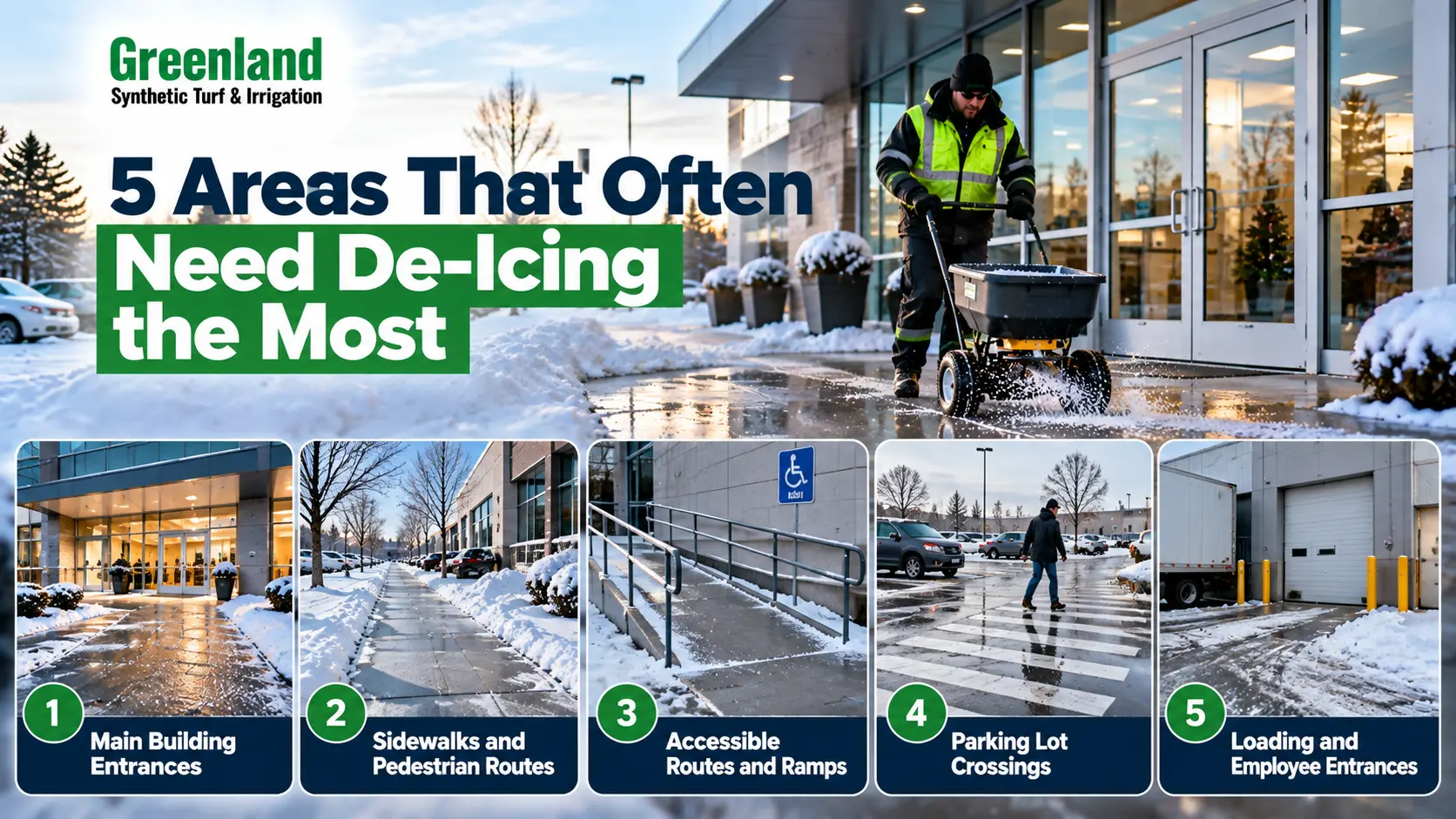
1. Main Building Entrances
Entrances receive constant foot traffic. Snow and moisture can also be tracked inside and back onto exterior surfaces.
Because these areas are frequently used, they should be included in the property’s regular winter inspection and treatment routine.
2. Sidewalks and Pedestrian Routes
Sidewalks connect parking areas to buildings, making them an important part of the customer and employee journey.
A clear parking lot does little to improve access if the walkway leading to the entrance is covered in compacted snow or ice.
3. Accessible Routes and Ramps
Ramps and accessible pathways require particular attention because uneven or icy surfaces can make navigation more difficult.
These routes should be clearly identified in the winter maintenance plan and checked as weather conditions change.
4. Parking Lot Crossings
Pedestrians frequently cross vehicle lanes between parking spaces and building entrances.
Snow and ice can accumulate at these transition points, particularly where plowed snow is pushed toward the edges of driving surfaces.
5. Loading and Employee Entrances
Commercial and industrial properties may have entrances that receive less public traffic but remain important for employees, deliveries and daily operations.
These areas should not be overlooked simply because they are not the main customer entrance.
What Professional De-Icing Services Can Include
The exact service will depend on the property, weather conditions and winter maintenance agreement. However, professional de-icing can form part of a broader approach that includes monitoring, treatment and follow-up.
A commercial winter plan may include:
- Monitoring high-risk areas
- Applying appropriate de-icing materials
- Treating sidewalks and pedestrian routes
- Addressing entrances and ramps
- Rechecking areas after freezing conditions
- Coordinating de-icing with snow clearing
- Responding to changing weather conditions
The timing of treatment is also important.
Applying a treatment after ice has already become heavily compacted may require more work than addressing developing conditions earlier.
For this reason, commercial de-icing in London Ontario should be planned around the property’s operating hours, traffic patterns and expected weather.
How Freeze-Thaw Cycles Affect Winter Property Maintenance
London, Ontario can experience periods where temperatures move above and below freezing.
These freeze-thaw cycles can create a repeating problem.
During the day:
Snow and ice melt → water forms → surfaces become wet
Overnight:
Temperatures drop → water freezes → icy surfaces develop
The cycle can repeat several times during a winter week.
This is particularly important around areas where water naturally collects or where snow is repeatedly pushed.
Property managers should therefore look beyond the immediate snowfall and consider what the weather is likely to do after the snow has been cleared.
Why Commercial Properties Need a Proactive Approach
A reactive approach usually means waiting for someone to report an icy area before treatment is arranged.
That can create unnecessary delays.
A proactive winter plan identifies important areas before the season begins and establishes how they will be monitored during changing weather.
Property managers should identify:
- Primary pedestrian routes
- Accessible pathways
- Building entrances
- Slopes and ramps
- Areas with poor drainage
- Frequently shaded surfaces
- Parking lot crossings
- Locations where snow tends to accumulate
This information can then be incorporated into the property’s winter maintenance procedures.
Professional de-icing services can be coordinated with snow clearing so that the property receives the appropriate treatment as conditions develop.
De-Icing and Snow Clearing Should Work Together
Snow removal and de-icing should not be viewed as two completely separate winter tasks.
Consider a commercial property after a significant snowfall.
First, accumulated snow needs to be cleared from parking areas and sidewalks. Once the surface is exposed, remaining moisture may freeze as temperatures drop.
If the property only addresses the first step, icy conditions can still develop afterward.
A more complete winter approach considers the sequence:
- Snow begins accumulating.
- Snow is cleared from priority areas.
- Remaining snow and moisture are monitored.
- De-icing is applied where appropriate.
- High-traffic areas are checked again.
- Additional treatment is provided if freezing conditions continue.
This type of coordinated approach can be especially useful for properties that operate continuously throughout winter.
Choosing the Right Snow Salting and De-Icing Approach
Not every winter condition requires the same treatment.
The appropriate material and application method can depend on factors such as:
- Temperature
- Surface type
- Snow and ice conditions
- Pedestrian traffic
- Property layout
- Environmental considerations
- Existing winter maintenance procedures
Simply applying more material is not necessarily a better strategy.
Professional winter maintenance should focus on applying the appropriate treatment to the areas that need it and adjusting the approach when conditions change.
Property managers should also understand what materials are included in their service agreement and how treatment decisions are made.
Why Sidewalk Conditions Deserve Special Attention
For many commercial properties, the sidewalk is the final part of the journey before someone enters the building.
A customer may find a completely cleared parking space but still encounter snow or ice along the walkway. An employee may have an open vehicle route but face difficult conditions around the staff entrance.
This is why sidewalk clearing in Ontario should be considered alongside parking-lot snow removal rather than treated as an afterthought.
A winter plan should follow the complete path through the property.
That includes:
- Vehicle entrance
- Parking area
- Pedestrian crossing
- Sidewalk
- Ramp or stairs
- Building entrance
Maintaining this full route creates a more consistent approach to winter property maintenance.
Building a Practical Winter De-Icing Plan
Before winter begins, commercial property managers can take several practical steps to prepare.
Map high-priority areas
Identify sidewalks, entrances, ramps, crossings and other areas that require regular attention.
Identify recurring problem areas
Look at where ice or standing water developed during previous winters.
Coordinate snow and ice services
Make sure snow clearing and de-icing responsibilities are clearly defined.
Establish monitoring procedures
Determine who checks the property after significant weather events and how additional service is requested.
Consider operating hours
A property that opens early in the morning may require a different service schedule from a business that operates later in the day.
Review conditions throughout the season
Winter conditions change, so the plan should be adjusted when snow-storage areas, drainage patterns or traffic conditions change.
When Should Commercial Properties Consider De-Icing Services?
There is no single weather condition that determines when every property needs treatment.
Instead, property managers should consider the combination of temperature, precipitation, surface conditions and property use.
De-icing may become particularly important when:
- Freezing rain is expected
- Snow is melting and temperatures are expected to drop
- Ice is forming on pedestrian routes
- Compacted snow has developed
- Water is freezing around entrances
- Overnight temperatures are below freezing
- High-traffic areas remain slippery after snow clearing
A professional winter maintenance provider can help determine which areas need attention based on current conditions and the property’s specific requirements.
Keep Commercial Properties Accessible Through Ontario Winters
Winter maintenance is about more than removing visible snow. For commercial properties, changing temperatures can create ice well after a snowfall has ended.
That makes de-icing services in London Ontario an important part of a broader winter maintenance strategy, particularly around sidewalks, entrances, ramps, pedestrian crossings and other high-use areas.
At Greenland Irrigation, de-icing and sidewalk clearing can be coordinated with broader snow-management services to help commercial properties respond to changing winter conditions.
A proactive approach gives property managers a clearer way to identify high-risk areas, plan service timing and maintain important pedestrian routes throughout the season.
When snow clearing, sidewalk maintenance and ice management work together, commercial properties are better prepared for the repeated snowfall and freeze-thaw conditions that Ontario winters can bring.
Frequently Asked Schema
What are de-icing services?
De-icing services involve treating snow and ice-covered surfaces to help manage icy conditions. For commercial properties, treatment may focus on sidewalks, entrances, ramps, parking areas and other high-traffic locations.
When should sidewalks be de-iced in London Ontario?
Sidewalks may require de-icing when freezing rain occurs, snow melts and refreezes, compacted snow becomes icy or temperatures drop below freezing after moisture accumulates on the surface.
Is sidewalk snow clearing the same as de-icing?
No. Sidewalk snow clearing focuses on removing accumulated snow, while de-icing addresses ice and freezing conditions that may remain or develop after snow has been cleared.
Do commercial properties need both snow removal and de-icing?
Many commercial properties can benefit from coordinating both services. Snow removal clears accumulated snow, while de-icing helps address icy conditions that can develop from freezing rain, melting snow and freeze-thaw cycles.
What areas should commercial properties prioritize for de-icing?
High-priority areas commonly include main entrances, sidewalks, accessible routes, ramps, stairs, pedestrian crossings, parking-lot walkways and employee or loading entrances.