
Snow plowing is an important part of winter property maintenance, but removing snow does not always eliminate slippery conditions. Residual moisture can freeze, compacted snow can form a hard layer, and changing temperatures can create icy patches across parking lots, driveways, sidewalks and building entrances.
For commercial property owners and managers in London, Ontario, winter salting and ice-control planning can help address these challenges. However, not every treatment works in the same way. Rock salt helps control ice under suitable conditions, while sand-salt mixtures can combine ice-control assistance with added traction. The right approach depends on the weather, surface type and condition of the property.
This guide explains how winter salting works, the difference between rock salt and sand-salt treatments, and what businesses should consider when arranging ice removal and de-icing services in London, Ontario.
What Is Winter Salting and How Does It Work?
Winter salting involves applying suitable salt to outdoor surfaces to help manage ice and reduce its formation or bond with the surface under appropriate conditions.
Rock salt, which primarily consists of sodium chloride, works by dissolving in moisture and lowering the freezing point of water. This can help loosen existing ice and limit ice formation when temperatures and conditions are suitable.
However, salt is not an instant solution for every winter condition. Its effectiveness depends on factors such as pavement temperature, the amount of ice, moisture, traffic and application rate. In colder conditions, ordinary rock salt may work more slowly or become less effective.
For commercial properties, winter salting is best considered part of a broader maintenance plan. Snow clearing, surface inspections, drainage management and appropriate ice-control treatments may all be needed throughout the season.
How Salt Is Used During Snow Removal Procedures
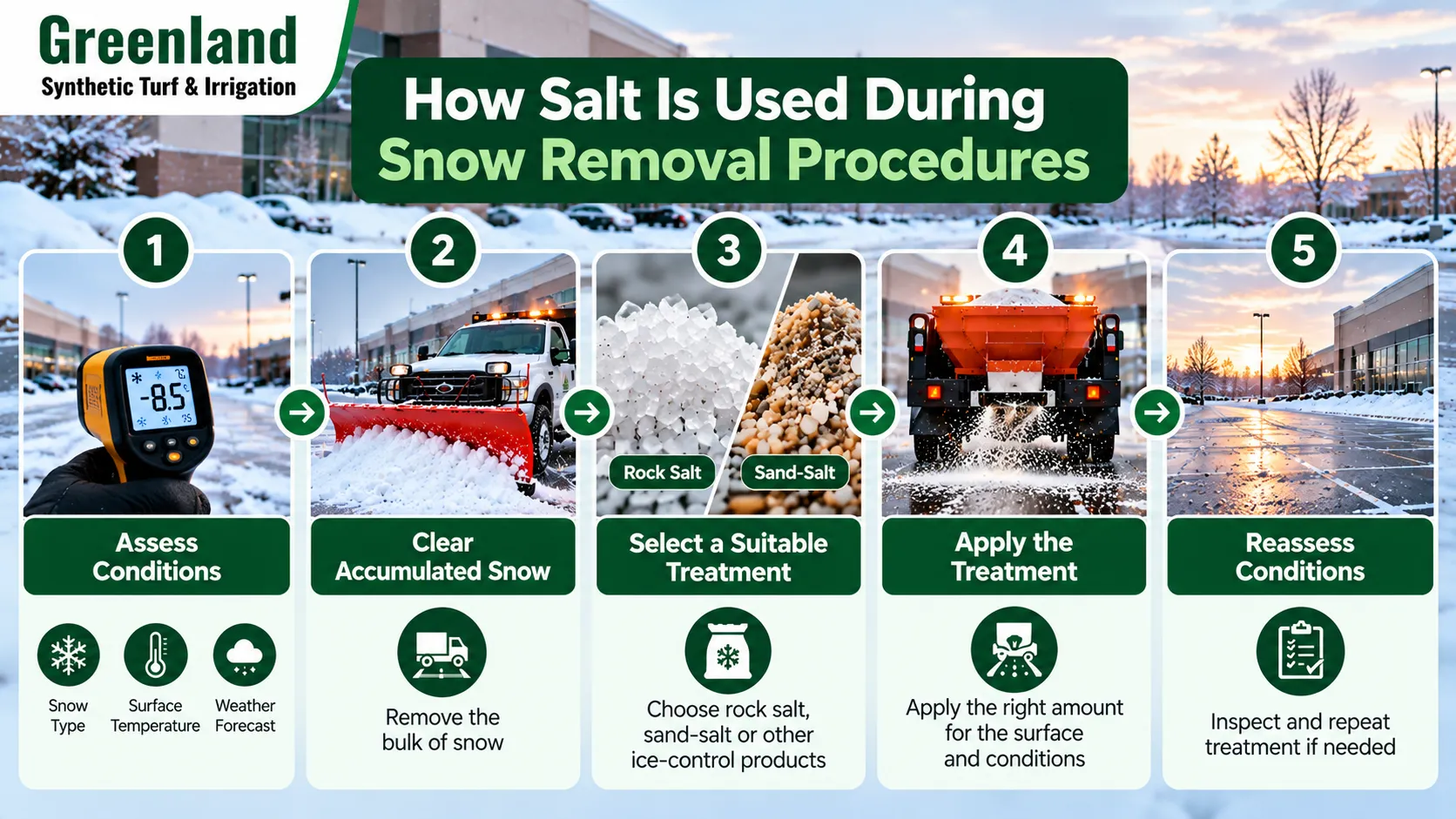
Effective winter maintenance involves assessing the surface before deciding whether salt or another treatment is appropriate. Applying salt without considering snow accumulation, temperature or site conditions may not produce the intended result.
A typical winter maintenance procedure may involve the following steps, depending on the property and agreed service scope.
Step 1: Assess Snow and Ice Conditions
The first step is to determine what is happening on the surface. Fresh snow, compacted snow, standing water and established ice may require different responses.
The assessment should also consider pavement temperature, forecast conditions, drainage, pedestrian movement and vehicle traffic.
Step 2: Clear Accumulated Snow
Where snow has accumulated, mechanical plowing or other suitable clearing methods are generally needed to remove the bulk of the snow before relying on salt for residual ice control.
Leaving deep snow in place and applying salt alone is not an effective substitute for proper snow removal.
Step 3: Select a Suitable Ice-Control Treatment
Rock salt may be appropriate when conditions support its use. A sand-salt treatment may be considered where a combination of ice-control assistance and abrasive traction is desirable.
Other de-icing products or methods may be more suitable under certain temperature or surface conditions. Treatment selection should follow the product instructions and the requirements of the site.
Step 4: Apply the Treatment Appropriately
Application should follow the product’s instructions and reflect the surface conditions. Using more material than necessary does not automatically improve performance and may increase costs or environmental impacts.
The appropriate application method depends on the treatment, the area being maintained and the equipment available.
Step 5: Reassess Conditions
After treatment, changing temperatures, continued snowfall or new moisture may create additional ice. Follow-up inspections and repeat treatments may be required depending on the property’s needs and the agreed maintenance plan.
This is particularly relevant for busy commercial parking lots, entrances, loading zones and pedestrian routes.
Rock Salt vs. Sand Salt: What’s the Difference?
When researching rock salt in London or sand salt in London, it is important to understand that these materials serve different purposes.
Rock Salt for Winter Ice Control
Rock salt is commonly used for ice control because sodium chloride can lower the freezing point of water under suitable conditions.
It may be considered for certain parking areas, driveways and other paved surfaces where ice needs to be managed. Its performance depends on temperature, moisture, the amount of ice present and correct application.
Potential benefits:
- Helps loosen or control ice under suitable conditions.
- Can complement mechanical snow clearing.
- Is widely recognised as a winter ice-control material.
Important limitations:
- Its effectiveness decreases in sufficiently cold conditions.
- It does not replace mechanical removal of large snow accumulations.
- Excessive or inappropriate use can contribute to corrosion, vegetation damage and chloride impacts on soil and water.
Property managers should confirm the suitability of salt for their surfaces, surrounding landscape and drainage conditions.
Sand-Salt Treatments for Traction and Ice Management
Sand-salt mixtures combine abrasive material with salt. The salt component helps with ice control under suitable conditions, while the sand can provide additional traction on slippery surfaces.
This combination may be considered for selected areas where traction is important, although the exact performance depends on the mixture, application and site conditions.
Sand does not melt ice in the same way salt does. It mainly provides an abrasive surface that can improve traction. It may also accumulate on the pavement and require cleanup after winter.
Potential considerations include:
- Whether additional traction is needed on the surface.
- Whether the salt component is suitable for current temperatures.
- Whether abrasive material may affect drainage or require later cleanup.
- Whether the treatment is appropriate for the pavement and surrounding environment.
If you are looking into sand salt in London, ask a winter maintenance provider which treatment options are actually available and suitable for your property.
When Should Businesses Arrange Winter Salting in London?
The need for winter salting depends on weather, surface conditions and how the property is used. Applying salt automatically after every snowfall may not be appropriate for every site.
Winter salting or other ice-control measures may be considered in situations such as:
- Residual ice remains after snow plowing.
- Meltwater is likely to refreeze as temperatures fall.
- Entrances, ramps or pedestrian routes develop icy conditions.
- Vehicle routes experience recurring ice under changing weather.
- Snow clearing has removed most of the accumulation but slippery patches remain.
Property managers should also consider the type of surface, nearby vegetation, drainage and the manufacturer’s treatment instructions.
For businesses seeking salting services in London, the best approach is to identify recurring ice-prone areas and establish clear treatment responsibilities before winter conditions become demanding.
De-Icing and Ice Removal: Why Both Matter
De-icing and ice removal are related but different parts of winter maintenance.
De-icing involves applying a suitable treatment to help loosen existing ice or manage icy conditions. Depending on the product, it may help reduce the bond between ice and the pavement.
Ice removal involves physically removing accumulated or loosened ice where appropriate. Depending on the surface and conditions, this may require mechanical methods alongside a suitable treatment.
Neither method should be treated as a universal solution. Established ice, very low temperatures and sensitive surfaces may require a different approach from a thin layer of ice on a suitable paved area.
Businesses looking for a de-icer in London should consider the expected temperature range, surface compatibility, application instructions and environmental implications before selecting a product.
Greenland Irrigation’s Snow & Ice Removal services provide a starting point for discussing winter maintenance requirements. You can also explore de-icing and sidewalk clearing for pedestrian access and ice-control needs.
Where Might Salt and De-Icing Be Needed on Commercial Properties?
Different parts of a commercial property may need different winter maintenance approaches. Treatment decisions should be based on actual conditions rather than applying the same material everywhere.
Parking Lots and Drive Lanes
Vehicle traffic can compact residual snow, while melting and refreezing may create icy patches. Snow plowing and appropriate follow-up ice control may be needed to maintain usable surfaces.
Entrances and Access Points
Entrances often experience repeated foot traffic and can be affected by moisture tracked in from surrounding areas. They may require regular inspection and suitable ice management.
Sidewalks, Ramps and Pedestrian Routes
Pedestrian surfaces may need separate clearing and treatment. Any product used should be suitable for the surface and applied according to its instructions.
Loading Zones and Operational Areas
Commercial and industrial sites may need particular attention around loading docks, vehicle routes and other areas where access is operationally important.
A site-specific winter maintenance plan helps determine which areas need snow clearing, which may require de-icing and where additional monitoring is appropriate.
How to Choose a Winter Salting and Ice-Control Service
When comparing winter maintenance services in London, Ontario, ask providers to explain how they assess conditions and determine the appropriate treatment.
Consider these questions:
- Is snow plowing included, or is the service limited to ice control?
- Which areas of the property will receive treatment?
- What materials and application methods are available?
- How does the provider account for temperature and surface conditions?
- Are repeat visits or additional applications charged separately?
- How are sensitive surfaces, drainage and nearby landscaping considered?
- Are service records available for completed visits?
Do not assume that every provider offers every type of salt or treatment. Confirm the actual materials, service scope and charges before agreeing to a plan.
A clear agreement helps property managers understand which services are included and how additional work will be handled during winter.
Plan Winter Salting and Snow Removal with Greenland Irrigation
Effective winter maintenance requires more than applying salt after snowfall. Snow clearing, ice assessment, suitable de-icing and follow-up inspections may all play a role in managing changing winter conditions.
Greenland Irrigation provides winter maintenance services for applicable commercial, industrial and multi-residential properties, with the service scope confirmed according to each property’s requirements and agreement.
If you manage a property in London, Ontario, explore the Greenland Irrigation website and review our Snow & Ice Removal services to discuss your winter maintenance needs.
Before selecting a treatment, confirm which services and materials are available and appropriate for your site. A property-specific plan can help establish priorities for snow clearing, ice control and pedestrian access throughout the winter season.
Frequently Asked Questions
1. What is winter salting, and how does it help with ice removal?
Winter salting involves applying suitable salt to help control ice under appropriate conditions. Salt dissolves in moisture and lowers water’s freezing point, which can help loosen ice. Its effectiveness depends on temperature, surface conditions and correct application.
2. What is the difference between rock salt and sand salt?
Rock salt primarily helps control ice by lowering the freezing point of water under suitable conditions. Sand-salt treatments combine salt with abrasive material to provide ice-control assistance and additional traction. The appropriate option depends on the site and weather.
3. When should businesses arrange winter salting in London, Ontario?
Winter salting may be appropriate when residual ice remains after snow clearing or when conditions favour ice formation. Timing and treatment should account for temperature, pavement conditions, traffic and the product’s instructions.
4. Does winter salting replace snow plowing?
No. Salt is not a substitute for mechanically clearing large accumulations of snow. Plowing removes bulk snow, while suitable salt or de-icing treatments may help manage remaining ice under appropriate conditions.
5. How do I choose a de-icer in London, Ontario?
Consider the expected temperature range, surface type, existing ice, product instructions and environmental impacts. Confirm which treatments are available from the service provider and whether they are suitable for your property’s requirements.